




Jon Wiener: From The Nation magazine, this is Start Making Sense. I’m Jon Wiener. Later in the Hour: Alice Waters, the legendary chef who founded Chez Panisse in Berkeley, will talk about how to make school lunch delicious, affordable, organic, and beautiful – and locally sourced from regenerative farmers. Her new book is A School Lunch Revolution. But first: Majorie Taylor Greene is out – and Zorhan Mamdani is in? Harold Meyerson will comment – in a minute.
[BREAK]
We’re still thinking about the wild week where Marjorie Taylor Greene announced she was quitting after Trump excommunicated her from MAGA. While on the same day, Trump welcomed Zohran Mamdani to the White House with open arms and high praise. What the heck? For comment and analysis, we turn to Harold Meyerson. He’s editor at large of the American Prospect. Harold, welcome back.
Harold Meyerson: Always good to be here, Jon.
JW: Let’s start with Marjorie Taylor Greene. On Friday, even her closest associates were stunned when she posted a 10-minute video on X announcing she would be leaving office January 5th, one year before her term expires. She’s the one who talked about Jewish space lasers starting forest fires, taking antisemitism to new heights. She promoted Trump’s claims of election fraud that led to the Capitol riot of January 6th, 2021.
In the last few months, though, she split from Trump on at least three fundamental issues: She called Israel’s action in Gaza “genocide.” She said Trump was wrong to cut healthcare. And she defied Trump on release of the Epstein files. Trump responded by calling her “Marjorie Traitor Greene” and said he’d endorse a challenger to her in the next primary. So she quit. The simplest conclusion we can draw is that if you don’t agree with Trump, you can’t be in the Republican party. Is that the way you see it?
HM: To a certain degree, yes. Marjorie Taylor Greene, if she’s to be judged only by her last month or two, has been coming around to what we might term “reality,” and it’s always a welcome development. When people do that, we encourage such excursions into what may be terra incognita for that particular person.
But also a couple of points. First of all, by announcing she would leave on January 5th, her term in office would then include five years, which makes her eligible for the Congressional pension. I suspect she’s been thinking about this for a while, even though she wasn’t telling anyone about it — precisely because at some point it occurred to her she could leave on January 5th and still collect her pension.
That said, she probably has some kind of future in the post-Trump Republican party, which will really begin to take shape after the midterm elections, when Trump, despite his best efforts to completely flout the Constitution, will be the lamest of ducks.
JW: I want to talk a little bit more about her critique in her 10-minute video, the kind of talk you hardly ever hear from elected officials: She said “during the longest shutdown in our nation’s history, I raged against my own party for refusing to pass a plan to save American healthcare and protect Americans from outrageous, overpriced, and unaffordable health insurance policies. The House should have been in session every working day to fix this disaster, but instead America was force fed disgusting political drama once again from both sides of the aisle.
“People know,” she said, “how much credit card debt they have. They know food costs too much. They know their rent has increasingly gone up, that the college degree they were told to earn only left them in debt and with no big six figure salary. They can’t afford health insurance or practically any insurance. And they just aren’t stupid.” Doesn’t that sound a bit like Bernie?
HM: Yeah, but for the reference to sharing on a bipartisan basis the blame for the shutdown, that could have been said by any mainstream to left-of-mainstream Democrat, and that obviously comes as a surprise. But as I said in my previous remark, we’ve got to welcome anyone who begins to grapple with what is the reality that most Americans have to live through today.
JW: Are you suggesting that she should or could become a Democrat?
HM: I think there’s still too many issues that would keep her from doing that — on the social side of the spectrum. But we have to acknowledge, and she’s apart from this, but we have to acknowledge sort of the Josh Hawley tendency within the Republican party to attempt to begin to grapple with the immense economic inequality in the United States. Josh Hawley is becoming what Thomas Paine would’ve called “a sunshine soldier” for some unions. This is all related to the Republican party increasingly seen as having a working-class base and the realization therefore of a number of Republican elected officials, not a lot, but some, that the working class is not making out at all well, and that traditional Republican economic policy is complicit in the sort of dismal state of economic affairs for the American working class.
JW: Yeah. What seemed to rankle her the most was being called a traitor. She said she had been loyal to Trump except for “standing up for American women who were raped at 14, trafficked and used by rich, powerful men.” She said, “that should not result in me being called a traitor and threatened by the president of the United States who I fought for.”
HM: Well, she has a very good point. I find nothing there to argue with a single syllable of. Trump’s criteria for traitor boils down to are you sufficiently pro-Trump today? So it’s actually a very low bar to clear, and as far as Trump was concerned, she had cleared it.
JW: Well, she’s in some ways a step ahead of most people. She said “Republicans will likely lose the midterms. Then I’ll be expected to defend the president against impeachment after he hatefully dumped tens of millions of dollars against me and tried to destroy me.” Well, that’s a good reason to quit.
HM: Yeah, you would think. I mean, if this were a legal brief based on facts, never mind legal precedents, there would be very little to quibble with.
JW: Then she went on CNN and said, quote, “I’m sorry for taking part in the toxic politics.” I have to say there’s some skepticism among some of our friends that she is really intent on pursuing a kinder, gentler politics. Do you share that?
HM: Well, I don’t really go into the prophecy business. If she runs for higher office, either statewide in Georgia or nationally in 2028, she still has to win votes from what is essentially the MAGA base. And so that will require her not to jettison all of her past customs.
JW: Yeah, the local Republican party in her district, this is north of Atlanta, issued a statement affirming its “unwavering support for her” and praised her for “working tirelessly to support the needs and views of her constituents.” But the same group declared in the same statement, “our support of Representative Greene does not in any way diminish our total support for President Trump.”
HM: Right. And if she runs for any other office, that’s still the electorate she has to grapple with.
JW: So she joins Liz Cheney and a actually pretty distinguished group of people — Senator Thom Tillis from North Carolina, who came to the same conclusion; there’s lots of others on this list.
HM: And of course, all of the old Bush neocons, most of them have long since bailed. Many of the Reaganites. Yeah, this is a different Republican party. It’s really a cult of Trump, and if you don’t want to be in the cult of Trump, odds are you will either find your own way or be booted out of the Republican party.
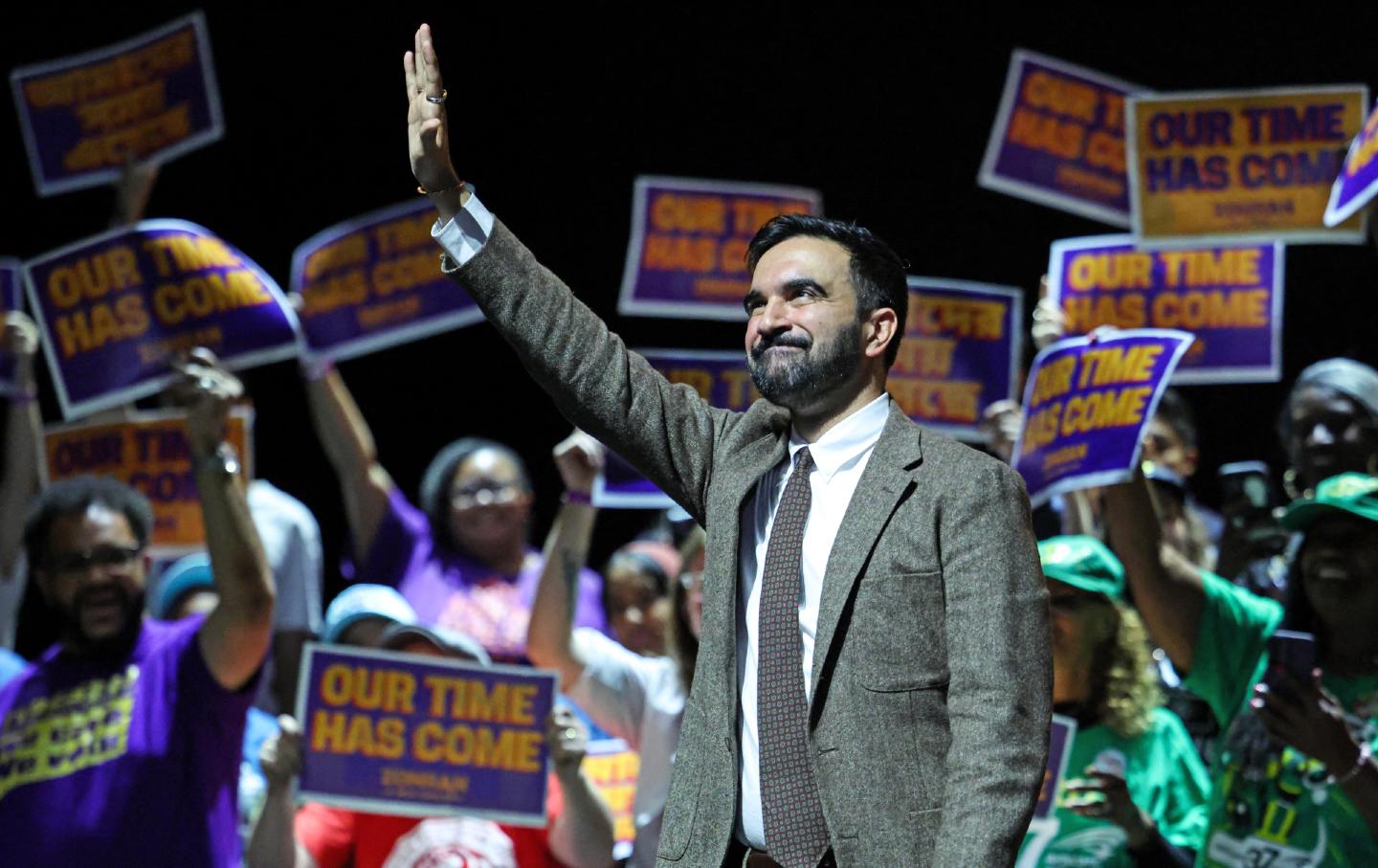
JW: The same afternoon, Mamdani went to the Oval Office. This is just after Trump called Marjorie Taylor Greene a traitor. Trump treated Mamdani in a warm and friendly way, expressed hope that Mamdani would be a “really great mayor” and that he was “confident that he can do a very good job.” The two of them agreed that cost of living issues were key in American politics today. And as for the police, the Republicans have been trying to paint Mamdani as anti-police. Trump said he would feel safe living in New York with Mamdani as mayor. He said he had no plans to send federal troops to New York City, which is a huge thing for Mamdani as he prepares to take office. Nothing about Mamdani being a communist lunatic or a stupid person, and nothing about withholding billions in federal funding from New York City. Instead, Trump said he’d “feel very comfortable” living in New York City with Mamdani as mayor. Trump told reporters, “we agree on a lot more than I thought. I want him to do a great job and we’ll help him do a great job.” Well, that’s a surprise.
HM: It is a surprise. Several observations. First, at kind of a fundamental level, Trump is sub- ideological. Trump’s value system is based on “what can you do and what have you done for me?” Now admittedly, Mamdani has not really done anything for Trump, but I think there are a lot of CEOs and Wall Street types who live in New York who understand that, if Trump does to New York what he tried to do to Los Angeles, what he’s doing in Chicago and now Charlotte, in a city as densely populated as New York, that could just lead to all hell breaking loose — or just perpetual gridlock, metaphoric and literal. And I think a number of those folks have spoken to Trump probably about all of that.
Also, from Mamdani’s point of view, look, Mamdani, I think historically quite correctly, cites Fiorello La Guardia as the greatest mayor of New York. But Fiorello La Guardia had the closest relationship with the president of the United States probably of any mayor of any city in American history. Much of what he was able to do in New York City was based on his personal conversations with Franklin Roosevelt and Roosevelt’s appropriation of lots of funds to New York City. And Mamdani completely understands that Trump has the power to really screw up New York. There are boats he does not need to rock.
And Trump loves a winner. That’s the other side of this, so, and Trump understands when someone runs a smart campaign. Trump valorizes winning above anything else, I mean, this is the flip side of his doing things like denigrating Americans captured in wars as prisoners of war, they were “losers,” therefore, and he’s expressed that opinion. So this was the weirdest of convergences. But weird is in addition to other through lines of the Trump administration. Weirdness is certainly one of ’em.
JW: The weirdest moment for a lot of us came when a reporter asked Mamdani about his having called Trump a fascist, and Mamdani kind of paused, and Trump jumped in and said, “You can just say it. That’s easier. It’s easier than explaining it. I don’t mind.” He says publicly, he doesn’t mind being called a fascist by the mayor of New York. What is going on?
HM: [LAUGHTER] Well, just as Mamdani admires fear Fiorello La Guardia, Trump may admire Bonito Mussolini. Choose your favorite person of Italian extraction. Like I said, weird is definitely au courant.
JW: And this post-ideological thing of Trump’s returns dramatically here.
HM: Trump has had the government buy or get a controlling share de facto in any number of corporations. That’s either called state capitalism or some version of socialism or whatever. He’s not really hemmed in, for better and worse, mainly worse, by the usual ideological constraints that have hemmed in every previous president of the United States and most of the people who go into politics.
JW: So where does this leave the Republican party? They had been planning to run a midterm national campaign that would put Mamdani at the center of their picture of the Democrats: Mamdani the Communist, Mamdani the Jihadist, Mamdani the Muslim radical, as the face of the Democratic party; anti-police, anti-capitalism, anti-Israel. Has Trump wrecked all that?
HM: Well, he sure has for now. I mean, I think, look, Republicans are going to need a theme at the moment. The economy is their enemy. They’ve tried to distract the gubernatorial campaign in Virginia. The Republican had, I think someone calculated, 50% of her ads were about trans people in women’s sports, and that had no effect. The Democrat won that race by 15%. And so what Trump with Mamdani certainly leaves the Republicans sort of desperately groping for themes.
I mean, this is a time-honored Republican tradition. A friend of mine showed me a little like one-minute video that Mamdani turned out in praise of a member of Congress in New York’s historic past named Vito Marcantonio, who was a protege of Fiorello La Guardia and represented East Harlem in the 1940s in Congress, but also was pretty close to the Communist Party in that he kind of followed what the American Communist Party did vis-a-vis foreign policy vis-a-vis the Soviet Union.
Well, the Republicans eventually tried to run against every Democratic member of Congress by pointing out, “look, he voted on the same side as Vito Marcantonio.” That is like voting to set up a post office in Omaha, Nebraska. But it was on the same side as Vito Marcantonio, and the Republicans clearly would like to have done this with Mamdani. I suspect they still will find a way to do it, but Trump sure gave them a major obstacle in the middle of that road.
JW: Of course, Mamdani doesn’t take office until January 1st, which is what, five weeks from now. Five weeks is a long time in Trump world.
HM: Trump may discover some ties to Satan himself that Mamdani has between now and January 1st. Or he may have discovered them on January 10th. So everything with Trump is provisional.
JW: One last thing this weekend: there’s a big consumer boycott being organized, a pause on shopping at three major corporations that have supported Trump, sponsored now by Indivisible, the Working Families Party, Black Voters Matter, and more. Together they issued a collective call for a boycott this weekend titled, “We Ain’t Buying It.” From Thanksgiving black Friday to Cyber Monday, they say, don’t buy anything from Home Depot, from Target, or from Amazon. Those are the three targets, because Home Depot has allowed its parking lots to become ground zero for ICE raid on immigrant day laborers and its billionaire co-founder Bernie Marcus has funneled millions into Trump’s campaigns.
They’re saying, don’t buy anything this weekend, black Friday through Cyber Monday, from Target. Target once branded itself as afriendly, inclusive big box store. Now it has scrapped its DEI goal, and scaled back its LGBTQ offerings to avoid angering Trump.
And don’t buy anything this weekend, black Friday through Cyber Monday, from Amazon. Amazon didn’t just shower Trump’s inauguration with cash. Jeff Bezos’ company pitched facial recognition tools to ICE, and Amazon Cloud services, powers, the Palantir system ICE uses to track and deport immigrants.
People say, “well, three companies — aren’t there lots of other companies that have supported Trump and contributed to his inauguration?” Ezra Levin of Indivisible explained it: “We want to concentrate our focus on Home Depot, Target and Amazon because we’ve seen that organizing is far more effective when it is concentrated, when it is easy to join. Doesn’t mean they’re the only three. They’re the ones, but they’re the ones we’re going to focus on this weekend.”
I wonder what you think about consumer boycotts. I myself was skeptical until the boycott of ABC and Disney actually brought back Jimmy Kimmel.
HM: Yes. Well, that was a particular incident which got sort of universal recognition. It was so much in the news that it produced a real backlash. I’m not sure this will produce that, a backlash on that scale, because there’s no precipitating one event that is dominating the news as the temporary sacking, we didn’t know was temporary at the time, of Jimmy Kimmel.
That said, Amazon controls just such a high share of American consuming, of American buying, that if you just really got something going at Amazon, that would be huge. But then again, of course, Amazon shopping is done on your phone or on your home laptop or what have you. So that’s kind of hard to mobilize as well. But I’m for whatever works. You and I are old enough to go back to the old grape boycott of the United Farm workers around 1970. So these things can have long-term and short-term effects, and Indivisible is certainly right that they really only work when you focus on just a handful of companies or a single company.
JW: So “We Ain’t Buying It” – from black Friday to Cyber Monday, not from Home Depot, not from Target, not from Amazon. More information online at weaintbuyingit.com.
Harold Meyerson — read him @prospect.org. Thank you, Harold.
HM: Always good to be here, Jon.
Jon Wiener: Now it’s time for “20 minutes without Trump”: a talk with Alice Waters about A School Lunch Revolution. Of course, she’s the chef who’s the founder and owner of Chez Panisse in Berkeley, winner of the National Humanities Medal awarded by President Obama, the French Legion of Honor Medal, the Julia Child Award, and three James Beard Awards. She’s also a Cavaliere of the Italian Republic. And she’s vice president of Slow Food International and founded The Edible Schoolyard. She’s the author of many books, including a wonderful memoir called Coming to My Senses: The Making of a Counterculture Cook, and many cookbooks, of course including The Art of Simple Food. This month she’s got a new one out: it’s called A School Lunch Revolution. Alice Waters, it’s an honor and a pleasure to say, welcome to the program.
Alice Waters: Thank you indeed.
JW: Your book, A School Lunch Revolution, has just been published, but you’ve been talking about school lunch for a long time. You wrote about it for The Nation in 2009. What’s new here is it’s not just about organic food, but it’s about connecting school lunch to regenerative agriculture — schools buying ingredients from local regenerative farmers and producers, and then cooking those ingredients onsite in school kitchens. I think we should start by explaining for those who don’t understand, what’s the difference between organic farming and regenerative farming?
AW: My first farmer was Bob Kennard and he told me he was a regenerative farmer, and I said, “what does that mean?” And he said, “because when you allow all the bugs and everything to be in the soil and you’re bringing in the compost to put in there, what happens is it pulls down from up there in the sky what should not be there and puts it in the ground.” And I said, “oh, is that so, Bob?
JW: You’re talking about carbon?
AW: Yes, talking about carbon, thank you very much. But he wanted me to put it on the menu way back when, and I said, “it’s hard to write that word there because it’s hard even to write organic 40 years ago.” And he said, “it’s very important that we think about that right now.” And so ultimately, we have put it on the menu. I thought both words were very important because of the high standard of organic and the fact that regenerative farming is directly relating to climate change. And since climate change is the really frightening future of this planet, I wanted to use both words in the book.
JW: From the kid’s point of view, I think the most revolutionary thing about your menus here is the vegetables. What you hear over and over when you do school lunch, I know this is true at your Los Angeles restaurant, at the Hammer Museum at UCLA, Lulu, they do lunches for kids who are visiting sometimes, and the kids say, every time, “I never knew vegetables could taste this good.” How do you do that? How do you do that with school lunch?
AW: We only buy fruits and vegetables in season. So when we have peaches or we have string beans, that is the moment that they are the most tasty. And if I’m back east and I’m picking apples in the fall, I remember my parents had a victory garden during the war and they canned all of the apples so that they would have them for the winter months. And I learned about canning from that time, but I’ve known about it around the world how foods can be preserved for different times of the year. And I mean, it’s very different tasting than fresh of that moment a vegetable or fruit, but it’s delicious in another way.
JW: A lot of people will tell you organic food is better, but it’s too expensive. One of your principles in this new book is affordable. And to me, the most amazing thing about a school lunch revolution is that all the menus fall within the cost guidelines of the Department of Agriculture School Lunch Reimbursement Program. That is something like $4.43 for lunch and $2.28 for breakfast. That seems almost impossible in our world today. How do you do that and keep it organic?
AW: You don’t have a middleman. That’s how you do it, a middleman who is taking his percentage and it costs more. From the very beginning, we bought directly from Bob, and he picked up all of our compostable food and it was what kept him completely loyal to us. And when the word got out around the state, every farmer wanted to bring food to us. And I loved it because as much as I love the community supported agriculture, making farmer’s markets available and for organic food, the farmer has to go a long way to get there, number one, very often has to go a long way, and they don’t know whether all the food’s going to be purchased, so they probably take some home, but if a school buys it, they buy everything and they pay the real cost because there’s no middleman and you’re buying from people that live nearby.
And I think it can work out even with farmers that are near each other, maybe you could pick up all the green beans from all the different farmers and bring them, but I just know that we need to support the farmers who are taking care of the land for us, for our health and the health of the planet. And I know also deeply that this is the way people have cooked since the beginning of time. Every country knows deeply about this. We’re one of the few countries that doesn’t. We started really learning about it during World War II though, and there are pamphlets that the United States government put out, and I’ve got a couple of them, but they’re so detailed about what you can plan exactly at what time of year, what soil, everything they give detail, and I want to get those printed and distributed, but I just know that we need a very positive program of food in schools that everybody can help make happen.
There’s a school of Red Marin that I use as a model. They started this conscious kitchen probably 10, 15 years ago, and it’s because the principal of the school said, “do whatever you want to.” And Judy Shills who started it, she said, “I want to have organic lunches. I want the students to sit down at long tables like we all used to do and eat their lunches together. What better place to learn democracy than at that table?” And she got the principal to agree. Then they started asking the parents whether they would help go to the farmer’s market, bring food, principal said “good.” And I was there the day that they were having milk brought right in from the regenerative farm right out there and the valley, and they were bringing it in a cool container, and they poured it in glasses at the table. And I haven’t had milk like that since New Jersey when I was a kid, and I was afraid I’d be embarrassed and couldn’t drink the milk, but it was so delicious, and I drank it and believe that they had fundraisers and I went to the fundraisers, but they raised as a school from parents and people that had seen this, all the money that was needed to keep the project going.
JW: I want to go back to that word delicious, which is one of your principles for school lunch. It’s got to taste good. The kids are going to eat it. Now in America, we have a culture where tasting good means fatty, starchy, sugary food, the kids have grown up eating, the way fast food is designed to appeal. But you want it to be delicious without those qualities, and you also want it to be simple. That sounds tough.
AW: Well, if I hadn’t made lunch for my daughter every single day when she was in middle school and high school, I wouldn’t believe that it was possible, but I saw her lunchbox when she brought it home, all of her friends, I had to finally start making more food that her friends could join in. And these are middle school children. They’re very picky according to the word of mouth around this country, but I didn’t find that at all.
First of all, they love to dip. So if you have integrate, you don’t trust the salad. You give them the leaves and they dip themselves, and it’s part of the way that something is prepared or not prepared on the table. They can’t deal with the whole apple. No. But if you cut that apple and slice the steak, the whole thing, and when a friend across the table says, “oh God, this is good!”all the kids at the table pick it up and eat it.
So it’s two things. It’s understanding the way they like that in their lunchbox, sort of separate, so they can choose how they’re going to eat it. But they also need to be in that circumstance of the table where people are eating something they’ve never had and say, “oh God, you ought to try this.” And they’re passing things around. It’s a beautiful experience to watch.
JW: Your final principle after delicious is that school lunch should also be beautiful. Now that seems like asking a lot, especially after delicious. A lot of people say delicious is enough. Well, if you’ve got delicious, you’ve got everything. But for you, beautiful is really important. What does it mean in a school lunch? And I know you start not just with the food, but with the space with the table itself.
AW: Yes, yes. I always start with the table. Maybe you can’t put candles on the table at school. Maybe you can, but maybe you can put a bowl of fruit on the table, maybe fruit that’s going to be served during the course of the week.
But I just feel like there needs to be a consideration either what the table’s made of or napkins that you’re using. And you probably can’t have cloth napkins, but maybe you can. And I just have always thought even in my daughter’s lunchbox that I may just pick a flower from the garden and put it in on top. And so when she opens the box, and maybe it’s as simple as a little extra bouquet of herbs that comes with the farm box, there’s always a way to make the table feel like we want this to be special.
Esther Cook, the main teacher at the edible schoolyard, she brought every day, flowers from her garden and she put them in the center of each table. Now I know those kids were affected by that, and she decided that at one of the classes that she would say to the kids, now it’s time for you to go to the garden or wherever you’d like and make the centerpieces for the table. And one I just loved. He took his boot and used it as the vase.
JW: Fantastic.
AW: And he put all the herbs in the boot and put the boot on the table. But that’s creative, that’s art. That’s seeing the potential of deeply what she was talking about.
JW: Your school lunch revolution is not vegetarian. This school lunch cookbook does have a section of recipes that include meat. What’s your approach to meat in school lunch?
AW: I think a little meat is fine. It’s fine. Maybe it’s a salad with roasted chicken in it. I’m not talking about a big piece of meat on a plate. No. I’m not talking about that, but I’m talking about maybe it’s a chicken stock that’s for a soup. I think meat can be good for proteins, like eggs, and we can’t just cut that out. I think there are ways you can – very limited, for flavor, and also and for health. I’ve always been concerned about health. All of my friends, in creating the restaurant, it always has something with meat, but it’s not a big piece of meat. It’s a small piece of meat. And as I said, they can it have a completely without meat. And that’s important too. If at school they don’t want the meat course, that’s fine.
JW: What I remember about my own middle school long ago was first of all the rush, and second, the noise. And I know the slow food movement is something very close to you that you’re a leader of, and we really need this in the school lunch too, I think.
AW: You’re exactly right. You’re sitting down together. There’s no rush because you don’t have to get in line. You’re going to sit down and have the food brought to the table. You can pause for a little moment before the dishes are put on the table. I know that this works because someone in my foundation who worked at Chez Panisse for a long, long time and has a child brought up, this child, has been doing a lot of work with Jen Newsom, Gavin’s wife, who’s got farm to school program happening in California. And so she’s been going to the schools, cooking the food from this book, putting it on the tables the way I imagined it could happen. And she took a couple of videos of the kids at the table, nearly made me cry. I mean, everything that I wanted to happen was happening there. They were talking, they were sharing, they were eating everything. And I just know from always having family meals and friends over and all the cooking that we do at the restaurant, that there’s always something that everyone will eat, always something. And they may not eat a bite of everything at the table, but what they eat is all good for them.
JW: “Food is the most political thing in all our lives,” you wrote in your memoir. “Eating is an everyday experience, and the decisions we make about what we eat have daily consequences, and those daily consequences can change the world.” Alice, thank you for everything you’re doing. Thank you for this book, A School Lunch Revolution; and thanks for talking with us today.
AW: Oh, thank you for giving me this very special opportunity.