



Politics
/
April 29, 2026
In its 6–3 decision, the court gutted the legislation that ended apartheid in this country—and once again gave white people the ability to suppress Black political power.
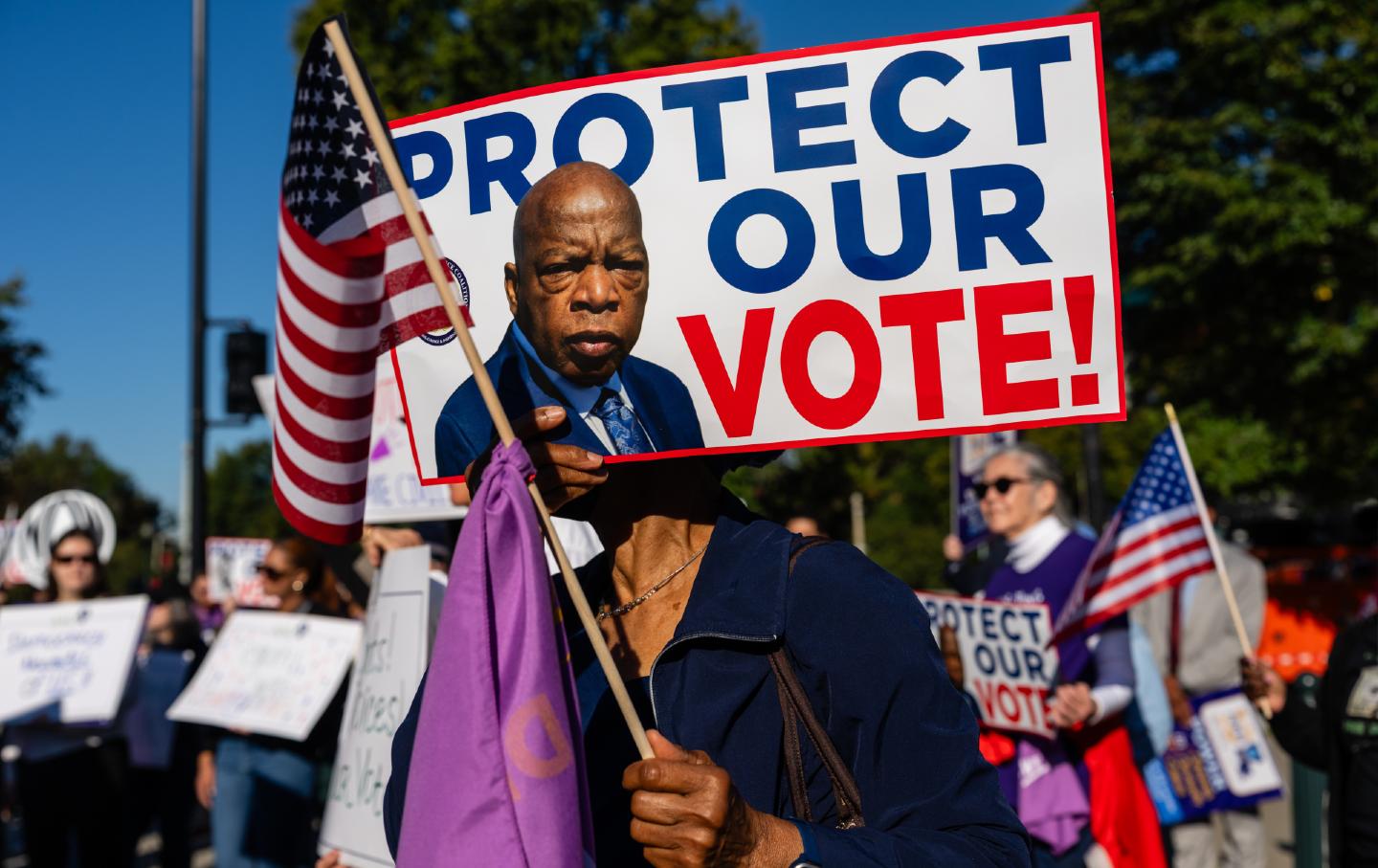
Demonstrators outside the US Supreme Court Building during oral arguments for Louisiana v. Callais, Oct. 2025.
(Eric Lee / Bloomberg via Getty Images)
The 1965 Voting Rights Act is the most important piece of legislation in United States history. It is the law that freed this country from apartheid. Before the Voting Rights Act—despite the Declaration of Independence and the Constitution and the Reconstruction Amendments and the various civil rights acts passed throughout history—the white majority could systematically disenfranchise Black citizens, as well as other minority groups. White folks could prevent non-white people from voting; they could make it harder for non-white people to vote; or they could simply make their votes not matter. And they could do this by means of violence, poll taxes, gerrymandering, and any other mechanism white people could dream up.
The VRA was the first piece of legislation that seriously tried to change this, to ensure every citizen the ability to participate in democratic self-government. It did this by enforcing the 15th and 19th Amendments and their prohibitions on denying the vote on account of race or gender. Remember, constitutional amendments mean nothing if there is no legislation to support them. Nobody, for instance, went to jail for having a beer in violation of the 18th Amendment’s prohibition on alcohol; instead, people went to jail for violating the Volstead Act (which attempted to enforce the 18th Amendment in the most draconian and stupid way possible). Similarly, every Black person alive in the South between 1865 and 1965 could tell you that nobody got to vote because of the 15th Amendment. Black people got to vote because of the Voting Rights Act.
To be clear, the VRA did not remove white supremacy from politics; it opened a door, and Black political power flooded into the white’s-only space of the US government. In 1964, there were only four Black people in Congress, and zero in the Senate. By 1968, that number had more than doubled to nine. Today, there are 67 Black people and 56 Latinos in Congress, the highest number for both groups in this country’s history.
The story is similar for women. In 1964, there were just 13 women in Congress; today, there are 154. (Always remember that the 19th Amendment did nothing for Black women, who have become the heart and soul of the Democratic Party, until the VRA got their back). And everybody should know that just 43 years after the passage of the Voting Rights Act, this country elected a Black president. The Voting Rights Act changed the face and the structure of American politics—and government.
Some people have never gotten over it—and six of those people sit on the Supreme Court. Chief Justice John Roberts has made it his lifelong crusade to oppose the Voting Rights Act and its democratization of political power. He opposed the expansion of the VRA when he was a young lawyer working in the Ronald Reagan White House, and he has done everything he can while on the Supreme Court to cut out the very heart of Black political power.
On Wednesday, Roberts and his cabal of ruling Republicans finally completed their quest to suppress the strength of the emerging non-white majority in this country. In Louisiana v. Callais, the court ruled, 6–3, that the Voting Rights Act cannot be used to protect minority political power from being diluted through gerrymandering. The ruling effectively ends the VRA, and with it the all too brief era of multiracial democracy in America.
Current Issue
The nuts and bolts of the decision are fairly straightforward. Louisiana has six congressional districts, and about a third of its population is Black. Mathematically, that means Louisiana should have two majority-minority congressional districts, but its 2020 redistricting allowed for only one. The state was sued under Section 2 of the Voting Rights Act and forced to draw a map with two Black districts. It did. Then white people sued, arguing that they were somehow constitutionally entitled to congressional overrepresentation, and that the two majority-minority districts discriminated against their white-bred interests.
In Callais, the Supreme Court ruled for the white people. It holds that the Voting Rights Act cannot be used to force Louisiana to draw a second majority-minority district. The majority opinion, written by Justice Samuel Alito, makes two key points:
- States cannot use race as a factor in districting even when those states are trying to prevent the disenfranchisement of nonwhite minorities.
- The Voting Rights Act only protects against intentional discrimination.
What this means in reality is that white people can gerrymander away Black political power, just like they did in the old days, as long as they say they’re only trying to take away Democratic political power. It means that even if you can show that the gerrymander was obviously targeted to dilute the Black vote and not the “Democratic” vote (as was the case in Louisiana, where neighborhoods full of white Democrats were left untouched but neighborhoods full of Black people were chopped up) it doesn’t matter unless the white gerrymanderers say something like, “I drew this map because I hate Negroes” or some other similarly vile statement bold enough to get Alito excited. It means that the Voting Rights Act is effectively dead.
I have to say “effectively dead” because Alito spends most of his opinion arguing that it’s not. He says that the VRA “properly construed” (emphasis his, not mine) still exists, it just has to be construed exactly as Alito wants it to be and not as Congress intended it to be. Congress explicitly intended the VRA to include “disparate impact”—the idea that a law that results in racism is indeed racist whether or not the racists who wrote the law admit to their nefarious plans. Alito’s construction explicitly rejects this concept. Nobody elected Alito or the other Republicans on the court to make this decision for us, but they’ve decided that only Republicans on the Supreme Court know what racism truly is.
Alito doesn’t want to say he’s killing the VRA; he just wants to turn it into a zombie. That’s a bit of a departure for Alito and for the Republican supermajority. After all, this is the same Alito who seemed almost gleeful when directly overturning Roe v. Wade and consigning women to second-class status. In this case, he clearly wants you to think, and the media to report, that the Voting Rights Act still exists. I suppose it is more comforting to white people if they are allowed to believe that they’re not living in an apartheid state again. The white folks who are against voting rights don’t all want to feel like they’re Elon Musk.
In dissent, Justice Elena Kagan brings clarity to what Alito tries to hide. She writes: “I dissent. The Voting Rights Act is—or, now more accurately, was—‘one of the most consequential, efficacious, and amply justified exercises of federal legislative power in our Nation’s history.’… It was born of the literal blood of Union soldiers and civil rights marchers. It ushered in awe-inspiring change, bringing this Nation closer to fulfilling the ideals of democracy and racial equality. And it has been repeatedly, and overwhelmingly, reauthorized by the people’s representatives in Congress. Only they have the right to say it is no longer needed—not the Members of this Court. I dissent, then, from this latest chapter in the majority’s now-completed demolition of the Voting Rights Act.”
The phrase “now-completed demolition of the Voting Rights Act” is the only analysis that matters. The VRA has been demolished, as the Republicans have long intended.
American-style apartheid was not constructed in a day, and multiracial democracy will not disappear in a night. Given that all the states interested in mid-decade redistricting already have their plans well underway, it’s unclear if, and I’d say unlikely that, this ruling will have a huge impact on the upcoming midterm elections. All it’s likely to mean is that states that were already trying to dilute the Black vote will indeed be able to dilute the Black vote. Florida will be bad, but Florida was always going to be bad, and this Supreme Court was never going to stop white-boots DeSantis from being bad.
The real bite of this ruling will come in 2030, when there’s a new Census and a new round of redistricting. That’s when we’ll see red state after red state dismantle Black and Latino voting power. Louisiana had one majority-minority district. It should have two. By 2030, it will have zero.
There’s only one way out of this, and it involves people using what voting power they have to to send people to Congress committed to multiracial democracy. Congress can overrule the Supreme Court on this. It can pass a new Voting Rights Act that explicitly defines what “intentional” discrimination looks like over and above what Roberts and Alito say it does. It can outlaw vote dilution. It can require disparate-impact analysis, and it can attempt to hold the Supreme Court to Congress’s interpretation of the Constitution through the practice known as “jurisdiction stripping.” Essentially, Congress can say “our interpretation of the 15th Amendment can be enforced by this new Voting Rights Act, and our interpretation is final.”
Popular
“swipe left below to view more authors”Swipe →
Beyond that, if Democrats take back the House and the Senate, kill the filibuster, and elect a Democratic president in 2028, Congress can pack the court and fill it with people who do not believe in a white’s-only theory of voting rights. Those new justices could overrule not just Callais but all of the other voting rights cases the Roberts court has issued to try to destroy minority voting rights. Those new justices could overturn the court’s prior gerrymandering decisions. A new court could reject the white supremacy the Roberts court embraces.
All of that will require a lot of political will, but it can start with the midterms. Democrats simply must take control of Congress and the Senate in November. Then, they must win the presidency in ’28, and hold that control through the 2030 Census. Thanks to Callais, this may be the last opportunity for Democrats to do so, because after 2030, if Callais has not been thrown in the trash, it will be very hard for Democrats to wrest political control from Republicans for decades.
Black people have used their political power to support the Democratic Party since the passage of the Voting Rights Act. In response, the Republican Party has set out to kill the VRA and reduce Black power to that of the Jim Crow era. Republicans have succeeded. We’ve got about four years to reverse their gains, or their victory will be complete.
The Voting Rights Act is dead. We need a new one, or the racists win. It’s as simple and as depressing as that.
From illegal war on Iran to an inhumane fuel blockade of Cuba, from AI weapons to crypto corruption, this is a time of staggering chaos, cruelty, and violence.
Unlike other publications that parrot the views of authoritarians, billionaires, and corporations, The Nation publishes stories that hold the powerful to account and center the communities too often denied a voice in the national media—stories like the one you’ve just read.
Each day, our journalism cuts through lies and distortions, contextualizes the developments reshaping politics around the globe, and advances progressive ideas that oxygenate our movements and instigate change in the halls of power.
This independent journalism is only possible with the support of our readers. If you want to see more urgent coverage like this, please donate to The Nation today.
More from The Nation
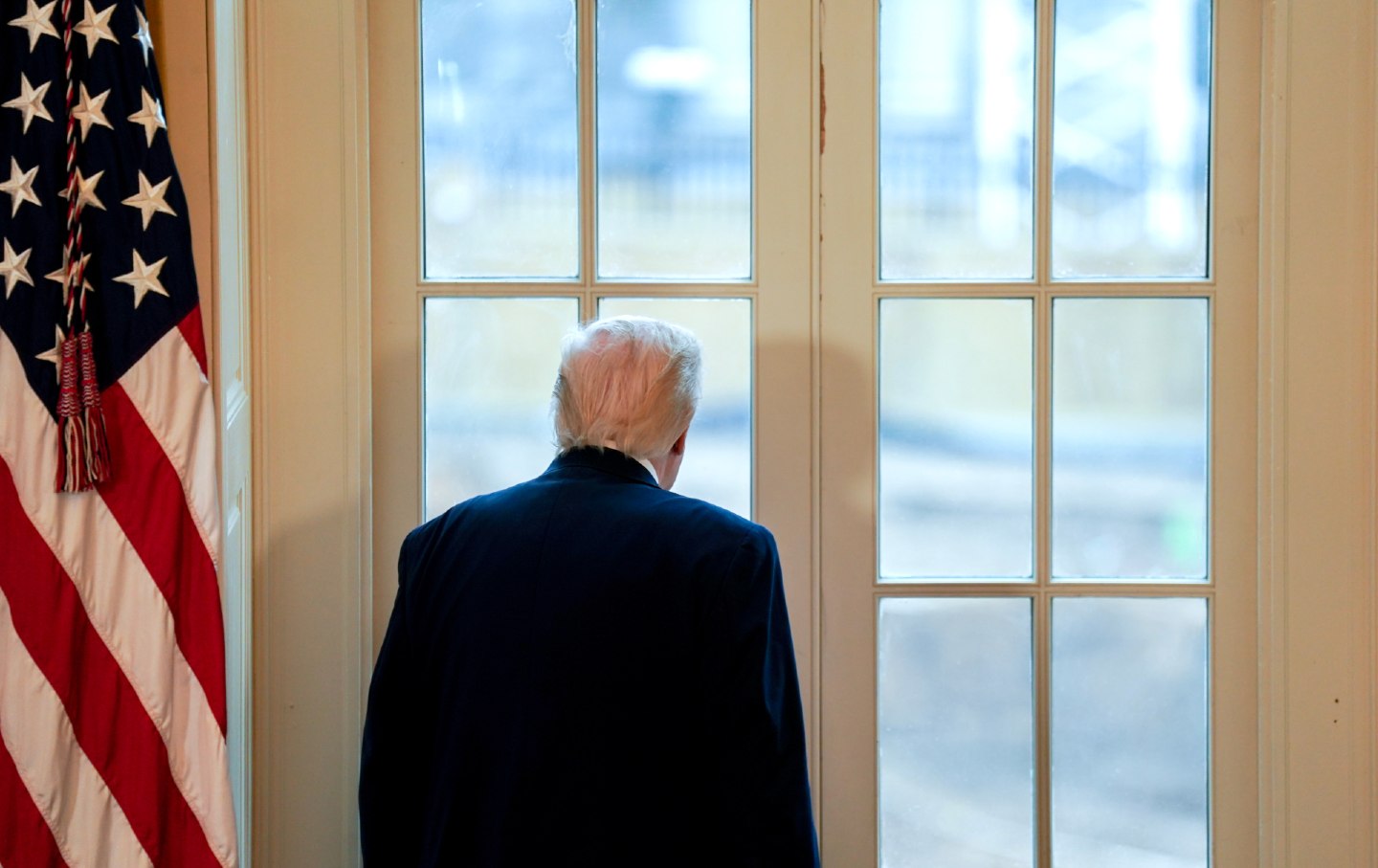
The president’s decision to commandeer the DOJ to argue that his ballroom is a security necessity is the ultimate sign that this country is in decline.
Elie Mystal
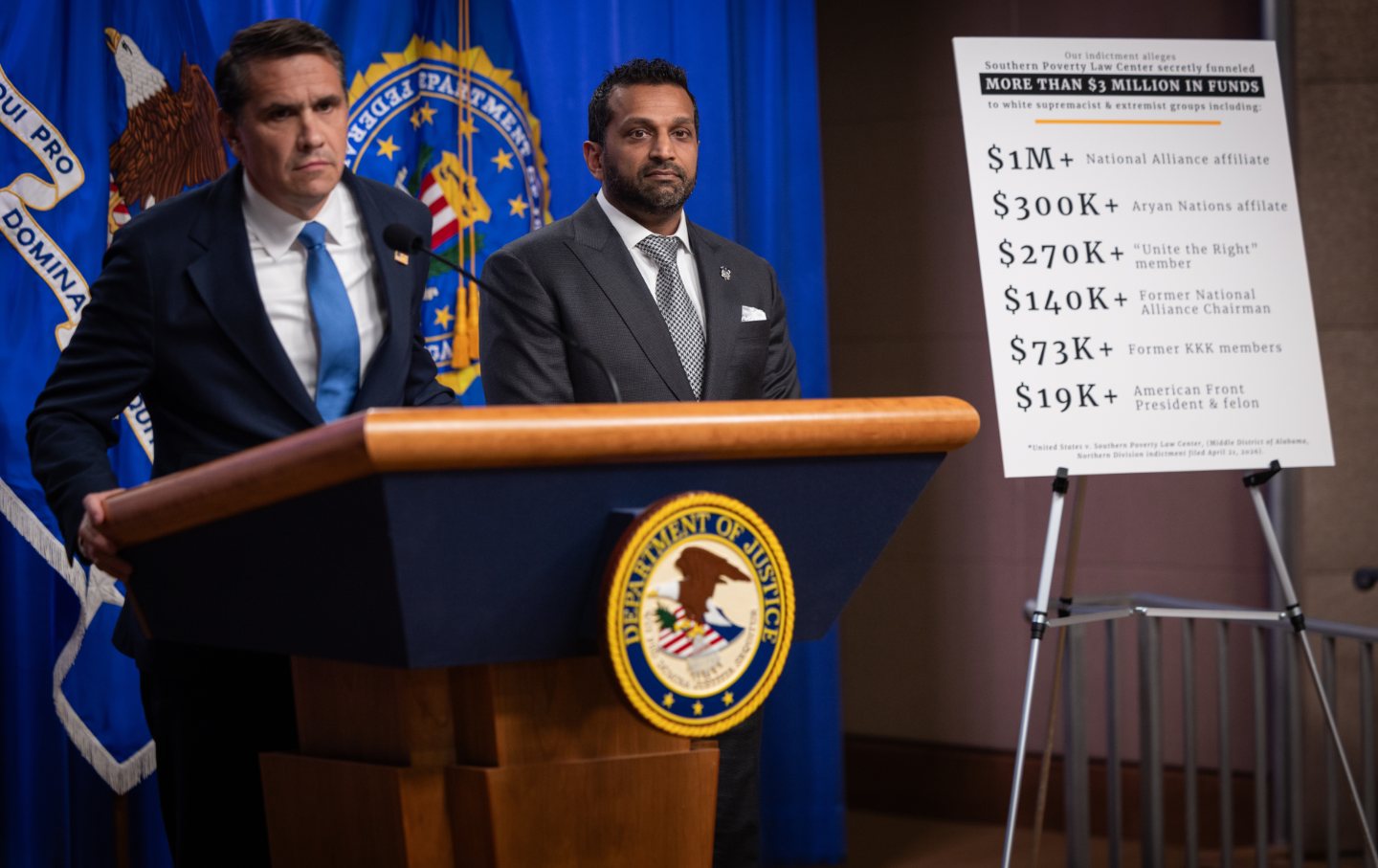
The case against the anti-hate organization will reassure racists that an organization that successfully tracks, exposes, and bankrupts them is now in the government’s crosshairs….
Kali Holloway
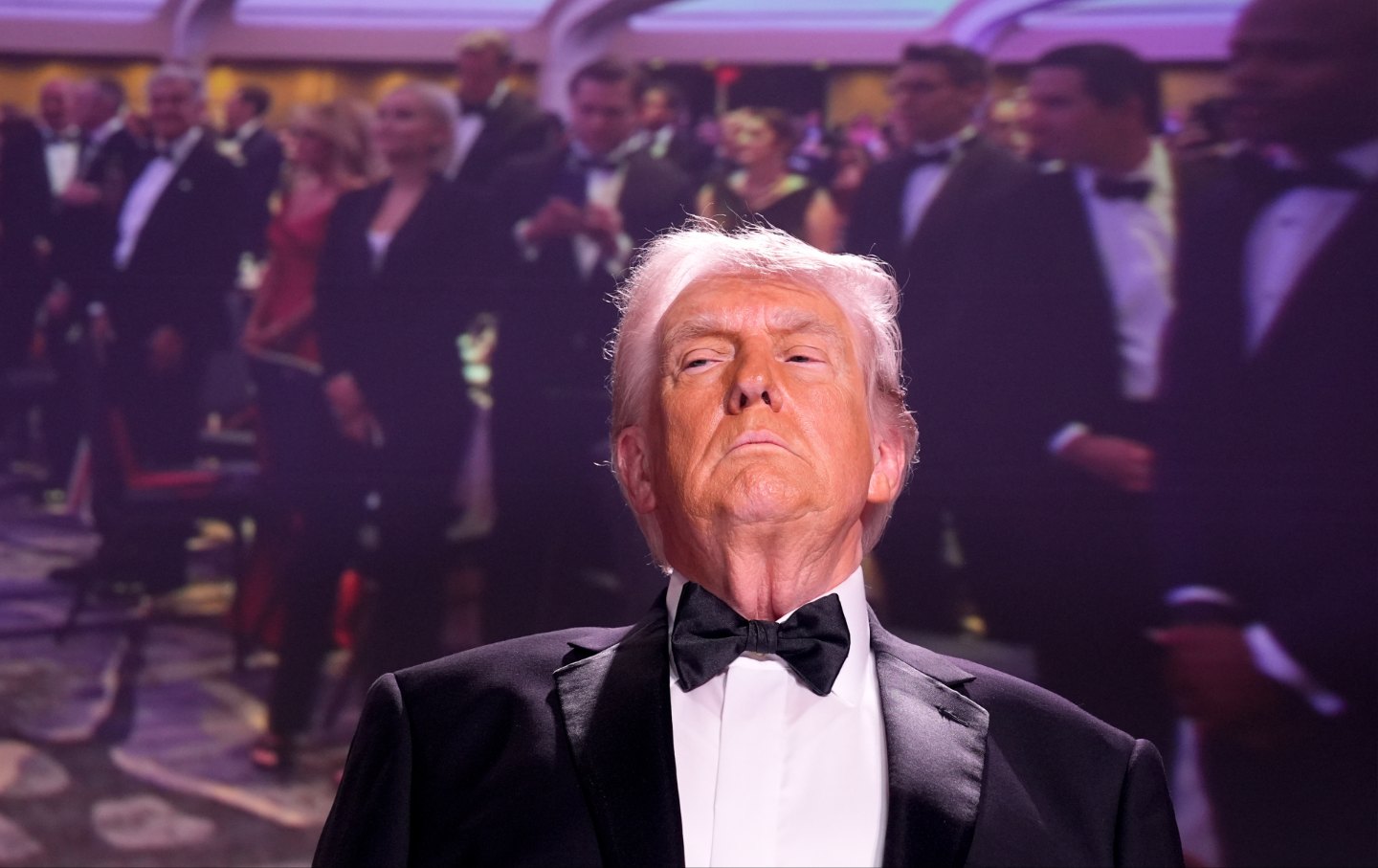
The president’s falsehoods about the White House Correspondents Dinner shooting continue a grim pattern.
Jeet Heer